Thursday, February 25, 2010

A Prairie as Wide as the Sea


Title: A Prairie as Wide as the Sea
Author: Sarah Ellis
Ages: 9-12
Rating: 5/5

Plot: Ivy Weatherall and her family are moving to the prairies of Canada from England. The day before she leaves, her aunt gives her a diary to record her adventures.

Assessment: The diary format allows readers to feel that they are able to become an intimate part of Ivy's life. Her diary is where she confides her feelings and secrets, and therefore into the reader.

This is an great way to get children (particularly girls) interested in Canadian history. Ivy describes many aspects of typical life as a young girl growing up on the prairies in the early 20th Century, something that is reinforced by the historical photographs at the end of the novel. This novel also has a certain quality of relevance even today, as it shows some intolerance for new immigrants.

If you liked this book, you should try others in the Dear Canada series. Or:
Out of the Dust by Karen Hesse
My Story series by Scholastic (for boys)

Ellis, S. (2001). A Prairie as wide as the sea: The immigrant diary of Ivy Weatherall. Toronto, On: Scholastic Canada Ltd.

U


Title: U
Creators: Gregoire Solotareff & Serge Elissalde
Ages: 6-9
Rating: 3/5

Plot: Mona is a lonely princess until one day U the unicorn appears. With U by her side, Mona grows up to be a happy and beautiful, though selfish teenager. Life is made more interesting when the Wewe's move into the forest nearby, especially as Mona finds she has feelings for the guitarist in the family.

Assessment: The film is lovely to watch as the colours are very bright, although the animation seems somewhat dated. The characters are lovable, except of course Mona's parents who are quite rude!

The story progresses really quickly, and I was often confused as to what the plot was or where the story was going.

Note: This film is in French, but may be played with the optional English subtitles.

Elissalde, S., & G. Solotareff. (2007). U. Montreal, QC: Prima Linea.

Wednesday, February 24, 2010

Breadwinner


Title: The Breadwinner
Author: Deborah Ellis
Ages: 9-12
Rating: 4/5

Plot: When Parvana's father is arrested there is nobody left to look after her family. In Afghanistan women are not allowed outside without a man. And so Parvana becomes a boy so that she might make enough money to feed her family, and with this new freedom Parvana learns that life is not easy for anyone anymore.

Assessment: Deborah Ellis' writing is honest as she reveals Parvana's frustration at being kept indoors because she is a girl, fear of the Talib, and hope for the future. Ellis is also forthright about what happens in Afghanistan and writes about violence against men and women by the Talib but also by family members against eachother.

This is book that I would recommended with care to an older or more mature child. Younger or more sensitive children may not be ready for the content in this book.

If you enjoyed this book keep reading about Parvana and Shauzia in the rest of the trilogy: Parvana's Journey and Mud City.

Ellis, D. (2000). The Breadwinner. Toronto: Groundwood books.

Tuesday, February 23, 2010

The Invention of Hugo Cabret


Title: The Invention of Hugo Cabret
Author: Brian Selznick
Ages: 9-12
Rating:

Plot: Hugo winds the clocks in the Train Station in Paris, but he accomplishes this in secret. But the even bigger secret is his father's invention. Hugo doesn't know the secrets it holds, but if he can fix the invention then maybe he can feel close to his father again.

Assessment: This is an interesting unique novel. The illustrations tell as much of the story as does the text. I don't often prefer reading graphic novels, because I find that I get much more out of a story with text. However, this novel is put together in such a way that I sometimes felt the text was supplement to the illustrations.

Selznick, B. The Invention of Hugo Cabret. New York, NY: Scholastic Press.

Jellaby


Title: Jellaby
Author: Kean Soo
Ages: 9-12
Rating: 4/5

Plot: Portia is lonely and having a tough time at school, until she meets a big purple baby monster in the forest. She names her new friend Jellaby and promises to help him find his family.

Assessment: This story touches on feelings of abandonment, as all three of the main characters seem to have lost touch with one or both of their parents. Portia and Jason both try to give the impression that they are tough, but we see their vulnerability at various points throughout the story. This is a two part story and I can't wait to read the next installment to find out more about the characters and whether they will find out where Jellaby comes from.

The illustrations are cute, and are often sweet or laugh out loud.

Soo, K. (2008). Jellaby. New York, NY: Hyperion Books for Children.

Swan Lake


Title: Swan Lake
Author: Margot Fonteyn
Illustrator: Trina Schart Hyman
Ages: 5-8
Rating:

Plot: Prince Siegfried must choose a woman to marry, but he cannot find a woman to love. Until one night, standing beside a lake he witness a wonderful transformation of a swan into a beautiful princess. Prince Siegfried vows to break the woman's enchantment and marry her.

Assessment: The narration by Margot Fonteyn helps to translate the ballet from the stage to paper. She effectively relates the wonder of Prince Siegfried towards Odette, and the Swan Princess' despair over her plight.

The smooth flowing lines of the Princess' and the maidens' dresses add a lightness and grace that almost gives the reader the impression they could blow off the page if the wind were too strong. The darkness of the night backgrounds help to make Odette shimmer with a feeling of magic and beauty.

Fonteyn, M. (1989). Swan Lake. San Diego, CA: Harcourt Brace Jovanovich.


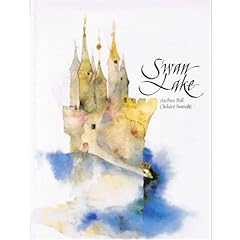
Author: Anthea Bell
Illustrator: Chihiro Iwasaki
Ages: 5-8
Rating: 3/5

Assessment: The writing in this version of Swan Lake is targeted towards a younger or more immature audience than that of Margot Fonteyn's. The story is simplified and as a result seems somewhat fragmented. The ending is has been altered to give the story a happy ending for more sensitive readers.

The watercolour illustrations are light and delicate giving the story a dream like feeling. The use of white space in the illustrations almost seems to encourage the reader's imagination to finish the artwork and imagine the action beyond what the pages are showing.

Bell, A. (1988). Swan Lake. Saxonville, MA: Picture Book Studio.

Hana's Suitcase


Title: Hana's Suitcase: A true story
Author: Karen Levine
Ages: 9-12
Rating: 5/5

Plot: A suitcase arrives for display at a children's Holocaust museum in Japan, but nobody knows to whom it belonged. Fumiko Ishioka, the curator, embarks on a journey to discover the previous owner of the suitcase. All she knows is a name, Hanna Brady.

Assessment: The journey of curator Fumiko Ishioka creates suspense for the reader as only parts of Hana and her history are revealed to us, just as Fumiko only discovers a little at a time about Hana.

The photographs found throughout help readers to better appreciate that the Holocaust affected real children, who had hobbies and friends. Even though the Holocaust happened a long time ago, children recognize that Hana was a regular little girl who didn't think what was happening was fair.

The story quality of this book, as well has having a heroine that children can identify makes learning the story of the Holocaust more tangible and a more approachable subject.

Levine, K. (2002). Hana's Suitcase: A True Story. Toronto, On: Second Story Press.

Ways to Live Forever


Title: Ways to Live Forever
Author: Sally Nicholls
Ages: 9-12
Rating: 4/5

Plot: Eleven year old Sam is writing a book about himself. There's a lot that he wants to know before he passes away from leukemia, and this book is his scientific record. He hopes that one day his book will help other children who have similar questions to his own.

Assessment: This novel is written from Sam’s point of view and expresses frustration, confusion and sometimes anger about questions he feels nobody will answer. He also shares with the reader his favorite things and best days. This book takes an honest position right from the start about what it means to be terminally ill, explaining what an IV is and why Sam doesn't go to school anymore. The novel also touches on the tension that illness creates in a family.

This would be an excellent book for children who may be ill themselves, or for children who have friends that are terminally ill because it offers them a window into typical fears and questions. Most importantly it stresses that sick children just want to be treated like they were before they were sick.

Nicholls, S. (2008). Ways to Live Forever. London, England: Arthur A. Levine Books.

Friday, February 19, 2010

How to Train your Dragon


Title: How to Train Your Dragon
Author: Cressida Cowell
Ages: 8-12
Rating: 4/5

Plot: Hiccup is a Viking hero, but he was not always very heroic. He is small for his age, doesn’t like to yell, speaks to dragons and on top of it all his dragon is toothless. But Hiccup proves that being a hero doesn’t only have to do with how loud you can yell.

Assessment: A good book for young boys who find humour in silly names like Fishlegs and Snoutlout, and some bathroom humour. The writing in this book uses some interesting fonts which help to make reading more interactive. The language while juvenile, does also give children an opportunity to add words to their vocabulary.

This novel while not entirely historically accurate, does include some elements that we know about Vikings such as the funeral ceremony and some of the descriptions of the landscape where they lived. The drawings included look like they were drawn by hand and by a young person, this makes it seem like Hiccup was actually telling his story when he was the 10 year old of the story.

If this book was a success recommend the rest of the series, or also try:
My Weird School (series) -by Dan Gutman
Captain Underpants (series)-by Dav Pilkey
Geronimo Stilton (series) -by Geronimo Stilton

Cowell, C. (2003). How to Train your Dragon: by Hiccup Horrendous Haddock III. London, UK: Hachette Children's Books.

The Bee-Man of Orn


Title: The Bee-Man of Orn
Author: Frank R. Stockton
Illustrator: P. J. Lynch
Ages: 5-8
Rating: 4/5

Plot: There once was a bee-man, he had no other friends than the honey bees. One day he meets a junior sorcerer who tells him that he has been placed under a curse. And so the bee-man sets out to find out what or who he was before the spell was cast upon him.

Assessment: This is a fairly typical morality tale about being true to yourself, with a slight twist in that the main character proves he was himself all along. While a good story, the narrative at times does become somewhat lengthy and dry, and the vocabulary would be daunting for a young child. This would not make a good storytime read as children may become bored listening to the story. This is a book that would be best read with a parent and child, or by an older child individually.

The artwork is beautiful and elaborate and children can become absorbed in the intricate detail of the bee-man's house, or in noticing the bee-like stripes of the bee-man's pants and other hidden treasures. As a bonus, this edition is accompanied by a CD-ROM which shows how the illustrator crafted the illustrations of this book -something that I would have loved as a child aspiring to be an artist when I grew up!

Note: Maurice Sendak previously illustrated this fairytale in 1964. His illustrations are reminiscent of In the Night Kitchen.

Stockton, F. R.(2003). The Bee-man of Orn. Cambridge, Ma: Candlewick Press.

Thursday, February 18, 2010

Sir Reginald's Logbook


Title: Sir Reginald's Logbook
Author: Matt Hammill
Ages: 5-8

Plot: Sir Reginald is on an adventure to retrieve a lost treasure; the Lost Tablet of Illusion. He must be brave and clever because there are many dangers to face in the jungle.

Assessment: The illustrations of the jungle scenes are bright with colour and have elaborate detail, while the events that occur outside his imagination are simpler and are in black and white.
Children will be entertained at the folly of Sir Reginald, especially as they are able to recognize how the scenes of the jungle translate into a landscape they are likely more familiar with.

I liked the way the illustrations seemed to come alive right of the pages of Sir Reginald's logbook; with the illustrations appearing to be painted over top of a lined notebook. The pencil drawings look like Sir Reginald himself could have drawn them. The text is also intriguing as it is written in the diary form that an explorer might actually record his experiences. The writing is clever and shows how a shift in perspective can change how situations or objects can appear quite different.

Note: Some parents may feel that the book makes light of the degradation of the mind of the elderly, while others may simply see a gentleman with an active imagination.

Hammill, M. (2008). Sir Reginald's logbook. Toronto, On: Kids Can Press.

The Gruffalo


Title: The Gruffalo
Author: Julia Donaldson
Illustrator: Axel Scheffler
Ages: 3-5
Rating: 5/5

Plot: During his walk through the woods Mouse meets animals in the forest who would like to have him for dinner. But the clever mouse tells each of them about his new friend the awful Gruffalo. This story allows Mouse to wander the forest safely until he meets an actual Gruffalo!

Assessment: The repetition in this story would help children to recognize it as a cycle so that they might look forward to the next section. The loose rhyme throughout the story is also a fun aspect that makes this an excellent book to read aloud.

Each time the Mouse describes the Gruffalo, he adds a new set of scary features -children could have fun acting out the "terrible claws" or the "poisonous wart at the end of his nose." The piece-meal illustrations help to add suspense, but the cartoon illustrations and the story ensure that it is much more silly than scary.

Donaldson, J.(1999). The Gruffalo. New York, NY: Penguin Putnam.

Sometimes I Like to Curl up in a Ball


Title: Sometimes I Like to Curl up in a Ball
Author: Vicki Churchill
Illustrator: Charles Fuge
Ages: 3-5
Rating: 5/5

Plot: Little Wombat tells us about his favorite activities; from curling up in a ball to standing tall. These activities keep him busy all day until he goes home at bedtime and curls up in a ball.

Assessment: This is a delightful story that can be as a book to encourage activity, or near bed. Children can mimic Little Wombat's actions like jumping up high, standing "still as a tree," or making funny faces. There is a light rhyme scheme that makes the story almost sing-song and makes it a great book to read aloud. The story gives the semblance of a day's cycle as it begins and ends with "sometimes I like to curl up in a ball," which is especially reinforced as we discover at the end that Wombat's favorite place to curl up is in bed.

The illustrations are vibrant and animated. The use of white in the background of the story, combined with shades of blue gives the impression of early daytime. This makes the end of day much more noticeable at the end of the story and gives the last page a cozy feel instead of a threatening one.
The lines of Little Wombat, with the little wisps of fur make him look fuzzy and soft, adding some interesting texture. The dark lines around each character really helps to bring them to life by separating them from the loose lines of the watercolour background. Fuge also did a great job with each of the animal and insect friends who seem to have individual expressions and personalities making them come alive with the story.

There is now a series of Little Wombat books for those who have enjoyed this one.


Churchill, V. (2001). Sometimes I like to curl up in a ball. New York, NY: Sterling Publishing Co.